Building Smarter, Greener, and Cooler
Sustainability is no longer a buzzword—it’s a standard. In Austin and across Central Texas, property owners, architects, and developers are increasingly focused on environmentally responsible building practices. One of the most cost-effective ways to improve a building’s sustainability profile is through high-performance window film. At Austin Stellar Window Films, our installations don’t just improve comfort and aesthetics—they contribute directly to measurable energy efficiency and environmental goals, including LEED certification (Leadership in Energy and Environmental Design).
The Role of Glass in Building Energy Performance
Glass is often the weak point in a building’s envelope. Large windows and curtain walls invite natural light, but they also allow solar heat, UV radiation, and glare to infiltrate the space. Without intervention, HVAC systems must work harder to compensate—leading to energy waste, higher costs, and greater emissions.
Professionally installed architectural window films mitigate those challenges by:
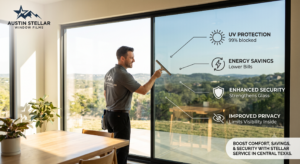
- Reducing solar heat gain by up to 80%, which lowers cooling loads.
- Blocking 99% of ultraviolet rays, extending the lifespan of furnishings and finishes.
- Enhancing thermal insulation, keeping indoor temperatures more consistent year-round.
These measurable improvements make window film a practical tool for owners and managers pursuing green building standards.
How Window Film Supports LEED Credits
LEED certification evaluates a building’s sustainability across multiple categories, from energy use to occupant comfort. Window film can contribute points toward several credit areas, including:
1. Energy & Atmosphere (EA)
By lowering HVAC demand, window film directly supports EA credits related to energy optimization. According to industry studies, reducing solar heat gain can lower cooling energy consumption by 5–15%, helping buildings exceed ASHRAE 90.1 standards.
2. Indoor Environmental Quality (IEQ)
Glare reduction and improved light balance enhance visual comfort and occupant satisfaction—key components of IEQ. Proper daylighting also reduces reliance on artificial lighting, further conserving energy.
3. Materials & Resources (MR)
Because window film upgrades existing glass rather than replacing it, it avoids the waste associated with full window replacements. Extending the lifespan of existing materials aligns with LEED’s focus on resource conservation and lifecycle value.
4. Innovation in Design (ID)
Advanced glazing retrofit solutions—such as solar control and spectrally selective films—may qualify under innovative strategies that improve performance beyond baseline LEED requirements.
Why This Matters in Central Texas
Austin’s combination of intense sun, long cooling seasons, and sustainability-focused building codes make window film an ideal retrofit. In older buildings, installing window film can deliver a faster ROI than replacing entire window systems, while contributing to Austin Energy Green Building (AEGB) and LEED for Existing Buildings benchmarks.
Austin Stellar Window Films has decades of local experience understanding how Texas heat and light interact with glass systems. The company’s expert consultants tailor each installation—balancing solar control, daylighting, and aesthetics—to maximize both comfort and sustainability benefits.
Common Applications for Sustainable Film Solutions
1. Commercial Buildings
Office towers, retail spaces, and hospitals benefit from films that reduce glare, improve comfort, and stabilize interior climates—without compromising visibility or light transmission.
2. Educational and Government Facilities
Public buildings often seek energy efficiency upgrades that deliver long-term cost savings. Window film helps schools and government centers meet sustainability targets and occupant comfort standards without disrupting daily operations.
3. Residential Homes
For homeowners in Austin, window film represents an affordable step toward sustainability. It reduces cooling costs, protects interiors from fading, and can even improve privacy—all while supporting energy conservation.
The Science Behind Sustainable Window Films
High-performance films use advanced coatings that selectively filter solar radiation. Here’s how they work:
- Spectrally selective coatings reflect infrared energy while allowing visible light to pass through.
- Low-emissivity (Low-E) layers minimize heat transfer between interior and exterior glass surfaces.
- Metalized and ceramic films provide optimal heat rejection with minimal reflectivity, preserving building aesthetics.
Each of these technologies contributes to a building’s energy efficiency, comfort, and sustainability profile—helping owners earn or maintain LEED status.
Case Study: Retrofitting for Efficiency Without Replacement
A common misconception is that achieving LEED points or reducing energy use requires major reconstruction. In reality, window film allows for an energy retrofit that avoids the environmental impact of removing and replacing glass.
For large facilities—universities, hospitals, or corporate campuses—window film installation can be completed quickly, with minimal disruption, and with immediate operational benefits.
Austin Stellar Window Films’ turnkey approach—from product selection to expert installation—ensures each project meets manufacturer and performance standards. Clients can expect a professional process backed by insurance, an A+ BBB rating, and nearly two decades of proven local experience.
Financial & Environmental ROI
Sustainability is most effective when it aligns with fiscal responsibility. Window film installation typically pays for itself within 3–5 years through reduced energy costs, depending on glass type and exposure. The environmental impact includes:
- Reduced carbon footprint from lower HVAC energy demand.
- Extended window system lifespan, minimizing material waste.
- Enhanced indoor comfort, leading to higher productivity and tenant satisfaction in commercial settings.
For property managers or developers seeking measurable energy savings, performance modeling tools can estimate annual cooling load reductions before installation—a service Austin Stellar Window Films often provides as part of its consultation process.
Why Partner with Austin Stellar Window Films
Choosing the right partner is essential. Stellar is not a generic tint shop—it’s a trusted architectural window film specialist with:
- Experience across residential, commercial, governmental, and institutional sectors.
- Partnerships with leading energy-efficient film manufacturers.
- Full insurance coverage and industry-recognized certifications.
- A commitment to clean, efficient job sites and transparent communication.
With a focus on long-term performance, sustainability, and craftsmanship, Stellar helps Austin-area clients transform their buildings into more efficient, comfortable, and eco-conscious environments.
The Bottom Line
For developers, property managers, and homeowners committed to sustainable design, professional window film is a practical, proven step toward achieving LEED certification and real-world energy savings.
By retrofitting existing glass systems with advanced solar control and low-E technology, Austin Stellar Window Films helps reduce carbon emissions, conserve energy, and enhance comfort—without sacrificing the daylight and views that define modern architecture.
Whether you manage a downtown office tower, a university campus, or a family home, sustainable window film is a smart investment in both your building’s future and the planet’s.